Monday, March 28, 2011

BYU Forum: Mark Zuckerberg on Increasing World Empathy and Connection

When I clicked “Maybe Attending,” on the “Mark Zuckerberg and Orrin Hatch to Talk Technology and Policy at BYU” event page, I mentally conceived an image of Senator Hatch giving a tedious power-point presentation (laser-point clicker in hand) on the future of web development as envisioned by Congress. How fascinating . . . His remarks would be followed (I presumed) by a nervous Zuckerberg, speaking (in a nasal voice?) primarily on how he is nothing like his character on The Social Network. I wasn’t particularly excited. But my husband wanted to go, so somehow I ended up in the Marriott Center on Friday morning, along with 10,692 others (according to Brigham Young University’s official facebook page).

Monday, March 21, 2011

A refugee, a legal permanent resident, and a Reagan-pardoned immigrant: Why are they up for deportation?

In March of  2009, a BYU sociology research team, UCIP (Utah County Immigration Project) conducted several interviews with ICE-Hold detainees at Utah County Jail. ICE-Hold detainees are immigrants who are not currently serving time for a crime, but are on "hold" under an Immigration and Customs Enforcement (ICE) detainer as they await the federal immigration court proceedings that precede deportation.

I summarize the histories of three particularly interesting detainees here to illustrate the complicated process immigrants go through in the justice system. Some of their quoted statements have been translated from Spanish. The names have been changed.

Sunday, March 13, 2011

Crime and Immigration: Facts and Fabrications


Utah’s public discourse on illegal immigration has greatly changed in the last few years. In 2009, the Utah legislature passed HB81, a law that allows local police departments to train their officers to enforce federal immigration law, and ups the consequences ($$$) for employing undocumented immigrants. But this year, the legislative session has churned out a couple of surprises.
Rather than passing Representative Stephen Sandstrom’s Arizona-like law (HB70) in it’s intended form, legislators modified the law, removing from it the provision that would have allowed police to ask immigration questions based on a “reasonable suspicion” that a person they stopped had illegal immigrant status. Perhaps, they didn’t want the anti-racial-profiling response that continues to affect Arizona. The law now requires officers to check the immigration status of anyone they arrest who is on a felony or class B or C misdemeanor charge, something the federal immigration police (ICE) do in the county jails anyway.
The legislature also passed Representative Bill Wright’s bill, (HB116), one that allows for a guest worker program for undocumented immigrants already living in Utah.
These laws continue to be controversial even among immigration activists. The guest worker program will cost immigrants a couple thousand dollars to join, and there’s still some question as to whether or not the federal government will consider a state immigration plan constitutional. However, these legislative moves are landmarks that indicate Utah’s famously ultra-conservative stance on immigration may have shifted to a more moderate position. The big question is, why? What sparked the change? The media has suggested these reasons:
  • The Utah Compact, a declaration of humane principles that should guide immigration legislation, which happens to be signed by several powerful groups and endorsed by one of Utah’s most influential organizations, The Church of Jesus Christ of Latter-Day Saints.
  • Business and Farm lobbyist arguments for the need of migrant labor.
  • Major efforts by the conservative media to portray undocumented immigrants in a more sympathetic light. (KSL, Deseret News)
  • New (2011) comprehensive research on undocumented immigrants and crime by Sutherland Institute and Brigham Young University, which reveals that of all the inmates in Utah jails and the state prison, only 5.4% are undocumented immigrants (3.8% if you don’t count the illegal-status inmates who have already served their criminal sentence and are simply detained as they await trial for federal immigration violation).
The last item was a brilliant response to a concern held by Utahns for the past few years that while very few reputable studies have been published to give us a clear picture of immigration and crime, politicians and activists have proposed conflicting answers based on estimations formulated without following academic standards essential for accurate statistics.
"There are three kinds of lies: lies, damned lies, and statistics." (Mark Twain)
The intent of this blog post is to discuss the nature of the immigration-and-crime concern, to describe the events leading up to the new research, and to reveal the flaws in previous research.

Sunday, March 6, 2011

Book Group Ladies Discuss Parenting and other Chinese Traditions

Mid-February, I was invited to join a group of LDS (Mormon) ladies from my neighborhood in their quarterly book group discussion. I was told we’d be reading Adeline Yeh Mah’s, Falling Leaves: The Memoir of an Unwanted Chinese Daughter, and asked if I would mind leading the discussion. I smiled to myself thinking that asking me to do so was a tricky way to get me to commit to come. How could I refuse? I thrive on flattery.

Purpose
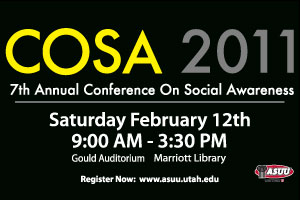
My primary purpose in posting these observational notes is to reveal a glimpse of two traditions: Mormon ladies’ book groups, and early 20th century Chinese familial customs. My secondary purpose is to report on an honest dialogue about race and culture, as encouraged by the leaders at the Critical Race Theory meeting I attended at University of Utah’s Conference On Social Awareness (COSA) February, 2011. 


Saturday, February 26, 2011

Critical Race Theory: Challenging Popular "Kumbaya Diversity" Paradigms

 
A couple weeks ago, I attended University of Utah’s annual Conference on Social Awareness.

On the drive over, I was nervous. I’d never been to a social awareness conference that you have to sign up for in advance. Would they make us stand in a circle and hold hands? Honestly, I wasn’t in the mood for audience participation. Already off to a rough start that morning (forgetting to set my alarm, sleeping in), what I really wanted was to sit in the back row of a large auditorium and take notes.

Tuesday, February 15, 2011

My First Day in America

For many Americans, the first big splash into another culture takes place during an expensive vacation:  fine dining in Paris, an historical tour in Egypt, a beach-side hotel in Costa Rica, or a Mediterranean cruise. All things strange and unexpected we perceive as exotic, and exciting. The candy-coating shell of Tourism shields us from the real culture shock we’d go through if we were to make another nation our home.

Thousands of Utahans are living the ultimate culture shock experience. We provide here a few of their stories.

The following are excerpts from essays written for a 2007 contest at Dixon Adult ESL Program in Provo, Utah. The essay contest took submissions from students of beginning to advanced English skill levels. The authors are adults of all ages, varying races, and nationalities. Some are permanent residents, others are undocumented. Enrollment at Dixon is low cost, and therefore the program attracts individuals of varying financial situations. The students were asked to describe their first day in the United States in English. From the many essays, I have gleaned a few interesting stories, and provide them here in several categories: Struggling with English, Being Taken Advantage of, Admiration or Dislike for New Lifestyle, Dealing with Discrimination, Interesting Border Crossing Experiences, and Feeling Welcome.

Friday, February 4, 2011

Leave No Wounded Behind

“We leave no wounded behind. Well, they can be spiritually and emotionally wounded, and they don't need to be left behind, either." 
 --Vietnam Vet, Formerly Homeless
***
Salt Lake City Public Library

Tuesday night last week, I attended a public screening for Street Vets by Isaac Goeckeritz, a new documentary on individuals living in Ogden's Homeless Veterans Fellowship (HVF), a VA program focused on helping veterans of the Vietnam War.