Showing posts with label Immigration. Show all posts

Wednesday, November 7, 2012

My survey: Finding out what immigrants think of Utah's new Guest-Worker Program (Part 1)

Utah's Guest Worker Program (Utah Immigration Enforcement and Accountability Act, formerly HB116) stayed intact through this spring's legislative session, despite some legislators' threats to repeal it. If things go as planned, the program will start granting state-approved legal work status to undocumented immigrants living in Utah next summer, 2013. Personally, I have high-hopes that this bi-partisan experiment will function successfully. But I have some questions about how things will pan out.

Utah Guest Worker Program Survey for Immigrants
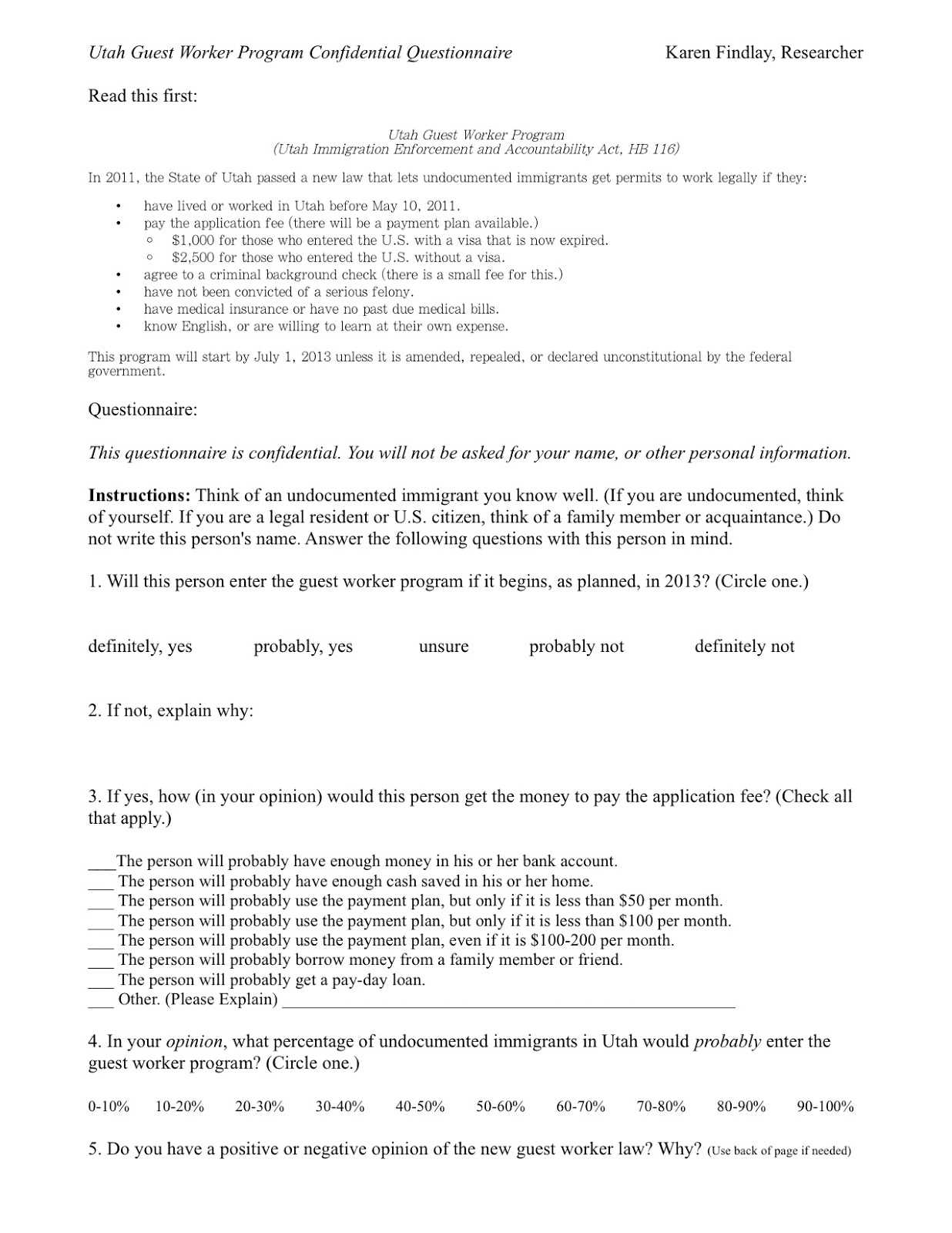
What percentage of undocumented immigrants will actually apply to enter the program? Is there a broad awareness of the program among Utah's undocumented immigrants? What are immigrants saying about it? Are there aspects of the program (in it's current form) that will deter many undocumented immigrants from getting on board? (I'm particularly interested to know if undocumented immigrants will be daunted by the high application fee ($1,500-$2,000), or if many are concerned about the fact that if the legislation changed after implementation of the program, the state would suddenly have record of thousands of immigrants without legal status.) To what extent does/will the immigrant community trust this program?

At any rate, I decided to put together a survey in which I ask immigrants (both documented and undocumented) for their opinions of the program, and their predictions of how well it will succeed without asking leading questions. To the left is an image file of the survey I came up with. (Click here to view or download document from Scribd.com). Thanks to some thoughtful friends, I have translations of the survey in Spanish, Japanese, Traditional and Simplified Mandarin Chinese, and Vietnamese.

My goal is to administer the questionnaire to about 200 immigrants. (I see this as more of a pilot study than a quantitative research project). So far, I've had only 47 participants.

Late spring this year (2012), I attended the Rose Park Community Festival, where I wheeled a toddler-bearing stroller, and wielded a couple of survey-bearing clipboards. I walked around for the last hour of the festival asking strangers if they were immigrants and if they'd be willing to complete a confidential survey. When I got home, I was amazed to discover that I'd only surveyed 10 individuals! That's when I decided I'd need to start searching for ELL classrooms.

Guadalupe School
Guadalupe School is a small community education center on Salt Lake's west side. They offer a toddler-preschool early education program, an elementary charter school program, and an adult English Language Learning program in addition to other community classes.

I visited the school twice last month to conduct my study with two classrooms of their adult ELL students. From the Monday night classroom, I administered 16 surveys, and from the Wednesday night classroom, 21. In both classes, the preferred language in which to take the survey was Spanish for every student. I was surprised how many students had questions about the Guest Worker Program before completing the survey. Maybe I should add, "Had you heard of this new guest worker program before today?" as an additional survey question.

Wednesday, January 18, 2012

Salt Lake community writers come together to share personal stories and feelings about civil rights

I love attending community events that give me something to write about. But sometimes, it can be really nerve-wracking. Once, I tried bringing my 1-year-old daughter to a debate, and was greatly embarrassed when we were asked to leave. On another occasion, after attending a civil rights conference, I was chastised by the organization head for not revealing my "journalist" status during registration. She tried to coerce me into not publishing my report on the event. I found it odd that a civil rights org would try to intimidate someone out of their first amendment rights. It's not like I'm discouraged about doing what I do here. But I have developed an edgy gut that finds me when I walk into events I plan to report on.

Community Writing Center exhibit panels set up
in the Sorenson Unity Center lobby 
I entered the Sorenson Unity Center, Thursday, Jan. 12th with that same edgy gut. The SLCC Community Writing Center was hosting a reading of the Utah Freedom Writers publication they recently put out. This is the civil rights writing project I participated in a few months ago. I was pleased to discover that over the course of the evening, my anxiety was easily assuaged, and more than that, I quickly felt admiration and kinship for the other writers, as well as the CWC staff.

Tuesday, December 6, 2011

26 Undocumented Teens

In honor of Human Rights Day (celebrating the UN's adoption of the 1948 Universal Declaration of Human Rights), the first floor of the Salt Lake City and County Building will exhibit a special photographic collection by Lynn Hoffman-Brouse (photographer) and Annie Brewer (social worker). I like to think of it as a small qualitative sociological study. The exhibit is entitled, DREAMers and contains photos and hand-written auto-biographical notes of 26 undocumented immigrant kids who would have benefited by the federal DREAM Act, a bill which did not pass (again) last year. Here's what the SLC Mayor's Office of Diversity and Human Rights says about DREAMers:
The photo exhibit brings awareness through portraits and stories of the unique plight of nearly 30 young, intelligent, hard-working students who came to this country as children, were raised as Americans, but have no legal status that allows them to work, vote or apply for student aid. The intent of the exhibit is to help eliminate the negative stereotypes and misconceptions that are associated with undocumented immigrants.
An opening reception will be hosted by the Salt Lake City Human Rights Commission and the Mayor’s Office of Diversity and Human Rights on December 10, 2011 at 6 p.m. at the City & County Building. Please RSVP to odhr@slcgov.com 
 The exhibit will be up December 1-31, 2011. The address of the Salt Lake City and County building is 451 S. State Street. But if you can't make it to see the exhibit in person, the online version of the photos and text may be found on the photographer's website.

Image and text of one of the 26 undocumented teens in the DREAMers exhibit


The DREAM Act (The Development, Relief and Education for Alien Minors Act) is a federal bill that has appeared in many different forms. It originated in the U.S. Senate in 2001. It was debated in Washington in 2001, 2007, 2009, 2010, and again last year (2011). It proposed a pathway to permanent residency (green cards!) and eventual citizenship for undocumented youth who:
  • Came to the U.S. before age 16.
  • Have resided in the U.S. for at least five consecutive years.
  • Are between the ages of 12 and 35 at the time of the bill’s enactment.
  • Have graduated from an American high school or received a GED.
  • Submit to a background check.
  • Have committed no felonies, and no more than 2 misdemeanors.
  • Are of “good moral character.”
Immigrants who meet these standards would be given conditional status for six years, during which time, they would be required to complete at least two years of college education or military service in order to then qualify for permanent residency.

Wednesday, October 26, 2011

Immigration Law and Workplace Anti-Discrimination Law have a relationship status: "It's Complicated."


David Littlefield is an adjunct law professor for
the University of Utah. He has specialized in
Immigration Law for over 30 years.
"I'm gonna talk about everything you ever wanted to know about immigration law in the workplace--then, I'm gonna tell you some things you didn't want to know." That was David Littlefield's opening statement. The event was the Salt Lake City Mayor's Anti-discrimination Seminar, September 27, 2011 at the State Bar Association building. Dave, a white gentleman with an impressive beard, was comfortable behind the podium, as if he'd given this presentation many times before. 

the audience, all 32 of us

I surmised that the group was mostly made up of lawyers--many said they were legal advisers for small businesses or locally headquartered corporations. The lady behind the meeting registration desk had asked me if I was

Monday, September 26, 2011

Why Study Culture?

Sameer and I both lived in apartments south of the university. We used to walk home together from the library.

"In my country," He loved to talk about Nepal, ". . . in my country, we never, never drop our parents to the old folk's home. They live in your house, you will treat them with respect. And when your father tells you what your career you will have, that is your career. That's how we do it. Family unity is more, more important than any desire of an egomaniac child."

And then it would be my turn. "In my country. . ." I'd try to explain how the American theme of Independence affects the way we live family life--but I couldn't do it without the sense of guilt for our inconsiderate and self-serving ways. I was enchanted by Sameer as he continued to offer me opportunities to question life as I knew it.

(image source)
I began to realize that what I had always thought to be human nature, wasn't. Culture is more than

Thursday, May 26, 2011

Utah Minutemen Project: Undercover Report

UMP participates in debate at Salt Lake City Library
The Utah Minutemen Project (UMP) is often pitted against immigration reform groups in public debates, and has found its way into the arms of Republican Party partnership. It seems like every time I read an immigration-themed article in a local newspaper, I find some quotation from Eli Cawley, UMP's long-time leader.

While I recognize that many conservative Utahns support deportation, I find it strange that Eli is so frequently called upon to represent mainstream Republican values.  I have, for several years, believed his views to be quite extreme, especially with regard to the UMP's essential belief that citizen's should literally take the border law into their own rifle-cocking hands. I met Eli in 2008, when I attended a UMP meeting and took notes. A couple of friends and I attended the meeting under the guise of possible interest in the cause, although our real intent was merely to observe the workings of the organization.

Arizona minutemen at the border (http://www.life.com)
 I'm interested in the sympathetic portrayal of all groups of people. Even groups that represent public efforts antagonistic to my own principles. I hope to offer a frank-and-fair peek into the values and views of the members of the Utah Minutemen Project. This can be best done, not through a rehearsal of my own opinion and analysis, but by presenting what was said and done while I spent some time among them. Below are my UMP meeting notes:

Monday, March 21, 2011

A refugee, a legal permanent resident, and a Reagan-pardoned immigrant: Why are they up for deportation?

In March of  2009, a BYU sociology research team, UCIP (Utah County Immigration Project) conducted several interviews with ICE-Hold detainees at Utah County Jail. ICE-Hold detainees are immigrants who are not currently serving time for a crime, but are on "hold" under an Immigration and Customs Enforcement (ICE) detainer as they await the federal immigration court proceedings that precede deportation.

I summarize the histories of three particularly interesting detainees here to illustrate the complicated process immigrants go through in the justice system. Some of their quoted statements have been translated from Spanish. The names have been changed.

Sunday, March 13, 2011

Crime and Immigration: Facts and Fabrications


Utah’s public discourse on illegal immigration has greatly changed in the last few years. In 2009, the Utah legislature passed HB81, a law that allows local police departments to train their officers to enforce federal immigration law, and ups the consequences ($$$) for employing undocumented immigrants. But this year, the legislative session has churned out a couple of surprises.
Rather than passing Representative Stephen Sandstrom’s Arizona-like law (HB70) in it’s intended form, legislators modified the law, removing from it the provision that would have allowed police to ask immigration questions based on a “reasonable suspicion” that a person they stopped had illegal immigrant status. Perhaps, they didn’t want the anti-racial-profiling response that continues to affect Arizona. The law now requires officers to check the immigration status of anyone they arrest who is on a felony or class B or C misdemeanor charge, something the federal immigration police (ICE) do in the county jails anyway.
The legislature also passed Representative Bill Wright’s bill, (HB116), one that allows for a guest worker program for undocumented immigrants already living in Utah.
These laws continue to be controversial even among immigration activists. The guest worker program will cost immigrants a couple thousand dollars to join, and there’s still some question as to whether or not the federal government will consider a state immigration plan constitutional. However, these legislative moves are landmarks that indicate Utah’s famously ultra-conservative stance on immigration may have shifted to a more moderate position. The big question is, why? What sparked the change? The media has suggested these reasons:
  • The Utah Compact, a declaration of humane principles that should guide immigration legislation, which happens to be signed by several powerful groups and endorsed by one of Utah’s most influential organizations, The Church of Jesus Christ of Latter-Day Saints.
  • Business and Farm lobbyist arguments for the need of migrant labor.
  • Major efforts by the conservative media to portray undocumented immigrants in a more sympathetic light. (KSL, Deseret News)
  • New (2011) comprehensive research on undocumented immigrants and crime by Sutherland Institute and Brigham Young University, which reveals that of all the inmates in Utah jails and the state prison, only 5.4% are undocumented immigrants (3.8% if you don’t count the illegal-status inmates who have already served their criminal sentence and are simply detained as they await trial for federal immigration violation).
The last item was a brilliant response to a concern held by Utahns for the past few years that while very few reputable studies have been published to give us a clear picture of immigration and crime, politicians and activists have proposed conflicting answers based on estimations formulated without following academic standards essential for accurate statistics.
"There are three kinds of lies: lies, damned lies, and statistics." (Mark Twain)
The intent of this blog post is to discuss the nature of the immigration-and-crime concern, to describe the events leading up to the new research, and to reveal the flaws in previous research.

Tuesday, February 15, 2011

My First Day in America

For many Americans, the first big splash into another culture takes place during an expensive vacation:  fine dining in Paris, an historical tour in Egypt, a beach-side hotel in Costa Rica, or a Mediterranean cruise. All things strange and unexpected we perceive as exotic, and exciting. The candy-coating shell of Tourism shields us from the real culture shock we’d go through if we were to make another nation our home.

Thousands of Utahans are living the ultimate culture shock experience. We provide here a few of their stories.

The following are excerpts from essays written for a 2007 contest at Dixon Adult ESL Program in Provo, Utah. The essay contest took submissions from students of beginning to advanced English skill levels. The authors are adults of all ages, varying races, and nationalities. Some are permanent residents, others are undocumented. Enrollment at Dixon is low cost, and therefore the program attracts individuals of varying financial situations. The students were asked to describe their first day in the United States in English. From the many essays, I have gleaned a few interesting stories, and provide them here in several categories: Struggling with English, Being Taken Advantage of, Admiration or Dislike for New Lifestyle, Dealing with Discrimination, Interesting Border Crossing Experiences, and Feeling Welcome.